
Go Wild With Annette: Sharks in British waters
One Planet News: Unravelling the secrets of whale sharks

By Annette J Beveridge
I was watching a wildlife documentary about diving with sharks, and it revealed the horrors of shark fishing. The camera focused on a string of hooks stretching across an expanse of water, and captured sharks just hanging there.
The dead sharks included Makos and Hammerheads. I found the whole footage deeply disturbing.
Every year, approximately 100 million sharks are killed in oceans across the world. This is a staggering number of dead sharks caught for the fin trade as well as shark oil, meat and cartilage. Many are caught unintentionally as bycatch.
Fishing practices are also a cause for shark deaths - long-lining, gill netting as well as bottom trawling. These collective methods are leading many shark species towards extinction, which would affect the whole ocean ecosystem.
In British waters
We have 21 species of shark living in British waters, and throughout the year, there are about 40 species that visit British waters.
Resident sharks
Deep water sharks include the black dogfish, Portuguese dogfish, gulper shark, porbeagle shark, nursehound shark and kite fin sharks. More than 50% of British sharks are deemed to be Threatened or Near Threatened.
Sharks are often feared, and it is true, they are the perfect predators.
When swimming off the British coast, you may be surprised to know that sharks may not be that far away. Rather than fearing them, we must protect them.
There are more than 500 species of sharks across the world, and far from being giant predators, many are no bigger than us.

Shark visitors
One shark that rarely moves into coastal waters is the thresher shark. It has been seen moving past the Devonshire coast in the summer and can survive in cold water due to adaptations. The thresher shark is endothermic, which means its body temperature remains higher than the waters surrounding it.
Then there is the blue shark. These are highly migratory sharks travelling huge distances - in fact, more than 5,700 miles (9,200km) on a trip. These have been spotted about 10 or 20 miles from Cornwall during the summer months.
The porbeagle shark is most often reported off the south coast, but the species has been detected in coastal areas around Pembrokeshire and North Yorkshire too.
The shortfin mako is considered the fastest shark, reaching speeds of 50 mph and as apex predators, prey species include swordfish and tuna. They can dive to depths of more than 400ft, and surge up from the water, reaching a height of 20ft. They are occasionally found in the seas around the UK and Ireland.
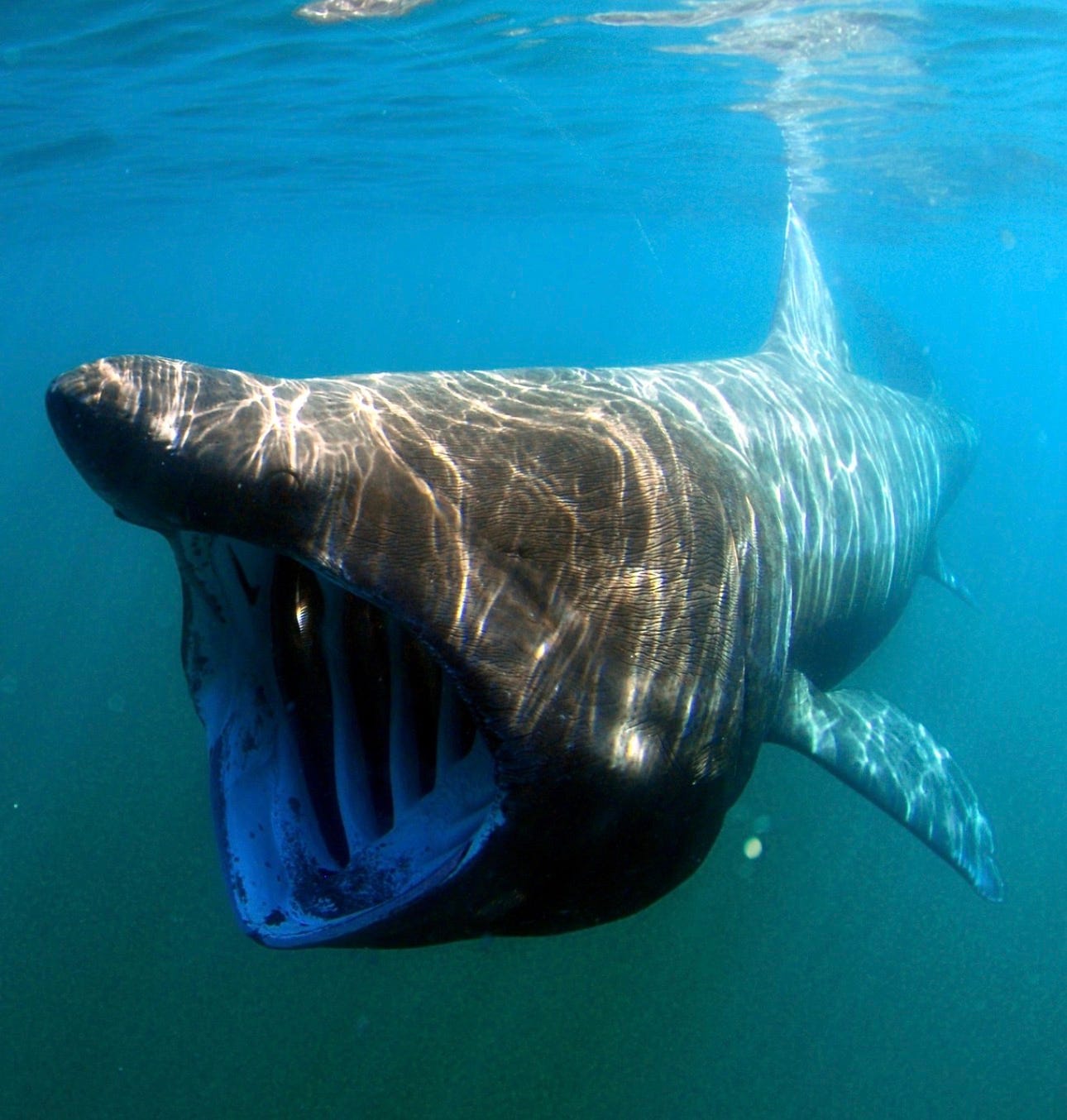
Of course, one of the most notable sharks in British waters is the basking shark, which is the second largest fish in the world, growing up to 12 metres.
These huge sharks feed only on zooplankton and filter them from the water, swimming with their large mouths open. They arrive here during the summer months to breed. Basking sharks have been seen in waters off the Inner Hebrides, Northern Ireland, and off the Isle of Man.
Basking sharks can be seen off the west coast of Scotland too between May and October. Watch out for signs of a large black dorsal fin, triangular in shape.
One Planet News
Unravelling the mystery of whale sharks

Studying the gentle giants of the ocean is not always easy, and whale sharks are notoriously difficult to track despite their title of being the largest fish in the ocean.
Growing up to 18 metres (60 feet), these filter feeders move through tropical and subtropical oceans searching for tiny plankton, fish eggs, and other microscopic prey.
With a mouth that stretches to four feet, and with rows of tiny teeth, whale sharks cannot bite or chew. Instead, they filter-feed with more than 6,000 litres of water per hour flowing through their gills.
Many snorkelers and divers have spent time underwater swimming alongside whale sharks because of their calm nature, but these are powerful animals and space and respect is important.
Patterns
Each whale shark has a unique spotted pattern spread over the dark skin, and this can be used to identify individuals.
These are not whales, despite the name.
They are valued for their fins, meat and oil and have become victims of bycatch. Whale sharks are listed as endangered on the IUCN Red List, and the species population is decreasing.
Whale shark congregations
There has long been a mystery about whale sharks’ movements as, despite their size, they can disappear for months at a time, travelling great distances and diving to deep depths. They usually travel alone, but there are times when many visit the same area. Here’s why.
