The Dragonfly's Secret Weapon
Go Wild With Annette

By Annette J Beveridge
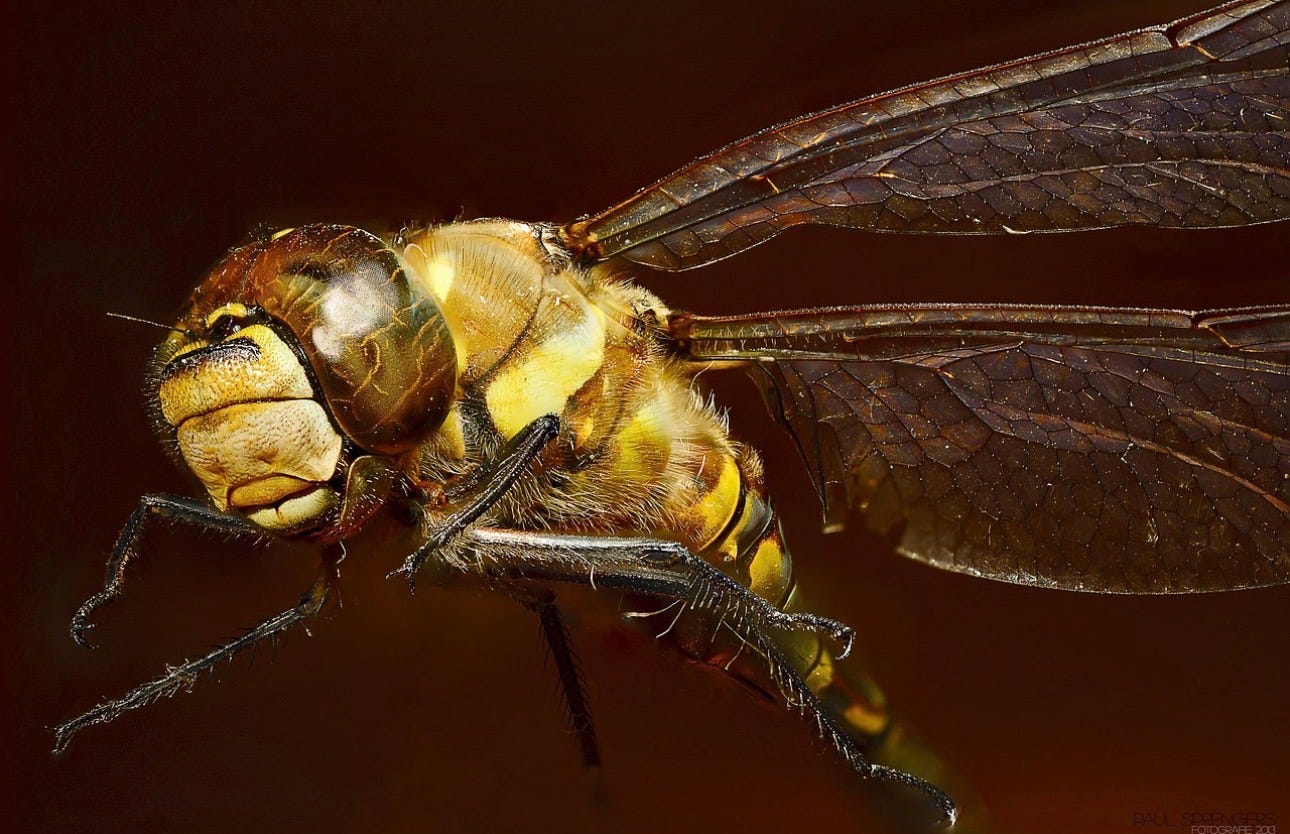
If you have ever just sat quietly by a lake, pond or river and let nature come closer, you may have noticed dragonflies and their enormous compound eyes.
The eyes are so noticeable and can meet in the middle… if looking at the top of its head.
Good eyesight is vital for dragonflies because their sense of smell is really limited and they are unable to hear.
Fortunately for the dragonfly, its vision is almost 360°, which explains why dragonflies often fly before you get near.
If you are ever able to look close at a dragonfly’s eyes, there are a mosaic of units, (ommatidia). Each point in a different direction and have a small lens. By comparison to us, where we have one lens per eye, a dragonfly can have up to 30,000 lenses per eye.
The dragonfly is able to interpret light and signals gaining a much clearer image than insects with smaller eyes. They also have a wide field of view, (FOV).
It is difficult to fully comprehend how a dragonfly might perceive colour but it is likely to be different to us. Dragonflies have up to 30 proteins in each eye which are interlinked with colour whereas we have three. It is possible that some species can detect ultraviolet light.
Dragonflies are fast and adept in flight which is helped by three ocelli (simple eyes) which have a single lens and are used for stability.
Next time you see a dragonfly, know that it is likely to have spotted you with a sharpness of view irrespective of your approach.